Tuesday, September 14, 2010

I Heart Book Sales

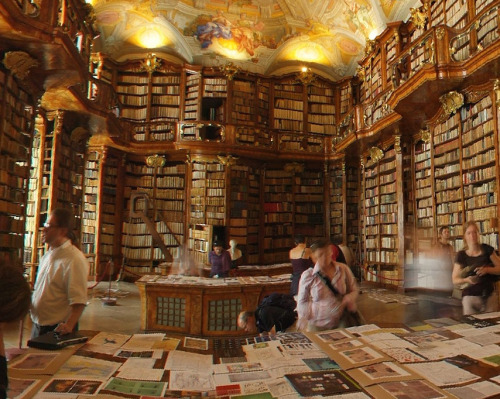
I cannot resist a book sale, especially if books on art and architecture are involved and even more especially if the proceeds are for a pet cause of mine. So attention friends: if you live in or plan on visiting the Queen City September 24th or 25th, don’t miss the Art, Architecture, & Photography Used Book Sale at Hodges Taylor Gallery in Uptown Charlotte. Held by the Friends of the Library, all proceeds benefit our local libraries and new boxes will be unpacked continuously so check it out both days if you can. And tell your friends because we in the industry need the reduced prices, Great Recession or no.

For all you dance, music, theater, and film devotees, the Friends of the Library will feature a Book Sale for those areas of interest on Saturday, October 16th, so mark your calendar.

Just in case you're due for an act of all-out altruism, pick up a book or two for me. I'll miss the sale due to a long scheduled trip – horror!

Sunday, September 5, 2010

Man Down: Novice Gaming and Writing for Laughs


Disclaimer: I’m not a gamer. My gaming days ended with Super Mario Brothers 2. I realize that makes me a luddite amongst my peers who at least know how to play Playstation, Wii, or Xbox 360. I know how to use an Xbox as a DVD player.

So I can relate to Nicholson Baker’s recent New Yorker article, “Painkiller Deathstreak,” where he relays the frustration and absolute ridiculousness of being a video game novice. Baker is a great writer and funny, too, which means he’s a really great writer. I love breezily inserted lines like “I wish so many foreigners didn’t have to be shot, so many historical sites damaged without comment, but evidently they do,” or in explaining the portrayal of his death in one game, “the image desaturates to black-and-white and there’s a tactful moment of funereal bagpipery.” When the hero of another game finds a precious, ancient green lamp, Baker empathizes that “being an American action hero, [he] immediately breaks it like a piggy bank on the floor.”

In On Writing Well, (one of my favorite books on the craft), William Zinsser describes humor as a “special angle of vision granted to certain writers who already write good English.” Baker’s account is fantastic humor, and it’s the writing that makes it so – that delicate combination of syntax, phrasing, and wit. Humorists do serious work, as any fan of satire knows, but the presentation sets it apart from other opinion pieces as something accessible if no less controversial.

A novice’s reflections on gaming may not draw great controversy, but gamers’ tolerance to depictions of violence is one of the underlying themes of the article. E.B. White believed, “Humor is a by-product that occurs in the serious work of some and not others.” The product of disparate ideas brought together to shed light on some truth however seemingly small, humor represents the quintessential creative act.

Thursday, September 2, 2010

Model City Economics

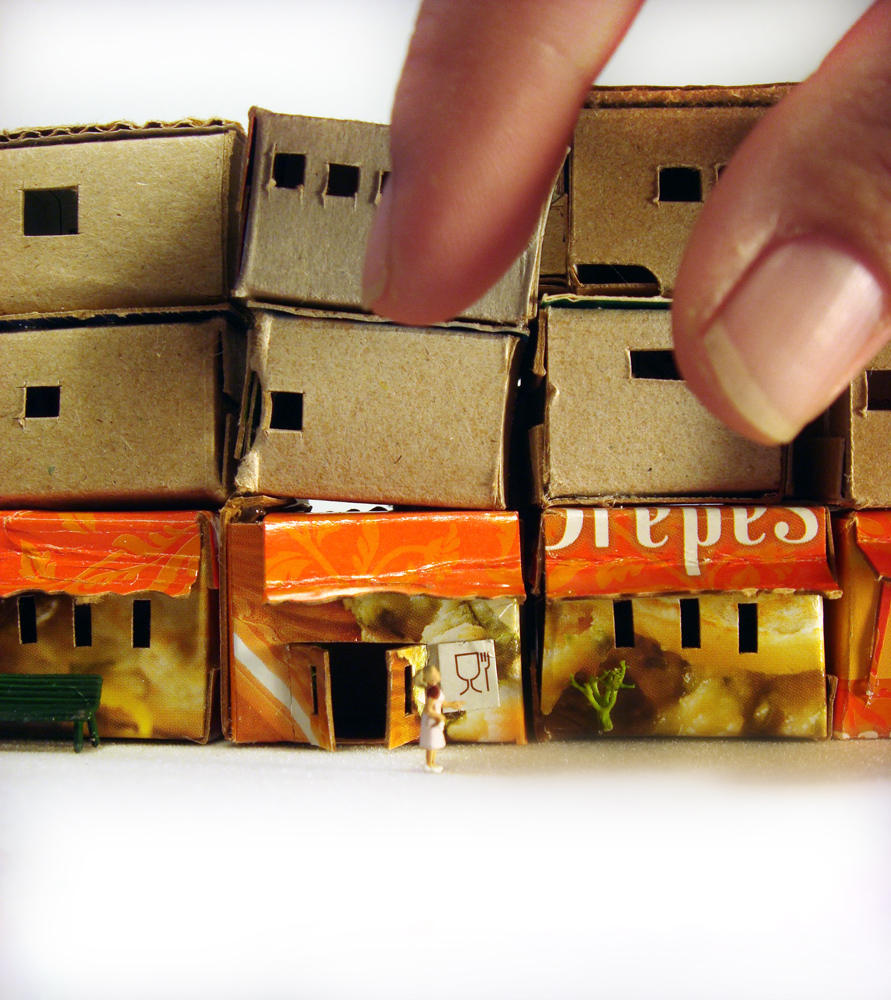
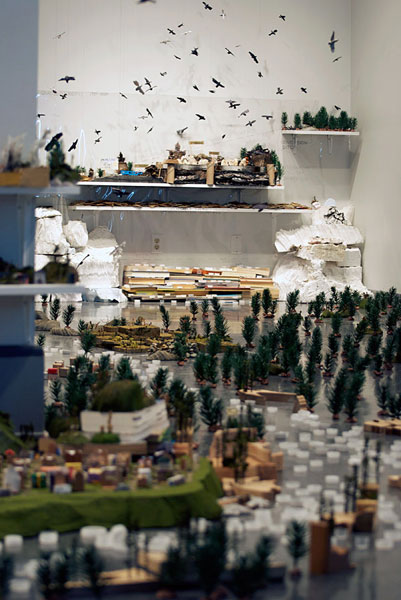
Model cities: who doesn’t love to look at miniatures of real life places and take in the bird’s eye view of a city made comprehensible by its micro-sized rendition. Now imagine that model being made of trash – reclaimed bits of detritus modeled, sculpted, and repurposed into backyards, condo towers, or the great lights of Broadway.

Enter Max Liboiron, an artist and academic who creates “walk-in, miniature dioramas” from a city’s discards. Her most recent work, The New York City Trash Exchange, opening September 9th at the AC Institute, represents none other than the great city itself and is, yes indeed, composed of New York City trash.

Max Liboiron, "The New York City Trash Exchange" (2010)
Liboiron’s work is more than a fun introduction to trash activism. Issues of economy and exchange value play out in the exhibition of the small cities.  In some cases, the parts of the installation are to be taken away by patrons free of charge since the visitor’s own trash might be included in the work itself.

Other installations are based on a barter economy. Visitors are free to take away a piece of the installation as long as they replace it with something of equal or greater value in return. The irony of gauging trash’s value is not lost on artist or viewer.

Max Liboiron, "The Dawson City Trash Project" (2008)
 Liboiron’s work also invokes the archeological, as in Material Afterlife: Circulation where she created 139 lawnscapes and 70 cars then tracked their location as they were taken away by gallery patrons. Liboiron mapped her sculptures’ movement across the continent, like so many migratory birds. For its lowly origins in the city dump, it’s hard not to see the poetry.

Tuesday, July 20, 2010

Marginal Behavior: Book Graffiti

In “Marginal," featured in the June 28 issue of The New Yorker, Author Ian Frazier relays his experience at the New York Public Library event focused around marginalia, aka those markings sketched into the body, cover, and/or margins of books, what NYPL's Anne Garner calls "book graffiti." Of course, the library wasn’t displaying just any marginalia. Selected from the library’s collection were the in-text scribbles of literary giants like Mark Twain, Jack Kerouac, William Coleridge, and Vladimir Nabokov to name a few.


Image from here
 For designers, marginalia are probably best equated with one of our favorite ideas – the palimpsest. Great marginalia takes on a palimpsest-like quality – the layering of thoughts, intersections, and outside references that inform and reform the text in question. This is why ebooks for all their convenience are lost on me. Sure, a digital book is great for a beach read I never plan on picking up again, but for those texts that are important to me, a digital highlighter will never replace the physical act of underlining an exquisite sentence or marking a particularly convincing passage. (Sue Halpern speaks to the digital marginalia problem in "What the iPad Can't Do" on the New York Review of Books blog.)


The most serious marginalians I’ve known in my life were philosophers. I once noticed that my philosophy mentor, a certain Mr. Casey, having read everything on the planet at least half a dozen times, created a key with dates on the inside front cover for his marginalia, i.e. black ink for the first read, blue for the second, pencil the third, double underlines on the fourth, and so on.

As an interpretive device, marginalia inspires a certain kind of faith. When returning to a text weeks, months, or years later, I always glance at my marks to get a feel for my prior readings of the material. I’m no longer surprised when my marginalia seem to be written by someone else – someone better read in some instances, more naïve other times, or enamored with an idea for a reason inconceivable to me today.

Read Frazier’s piece and decide what sort of marginalia-maker you are (I’ll admit I enjoy hostile marginalia or what I’ll call satirical marginalia, but seeds of ideas and cross references fill most of my margins).
Do you have a good example of marginalia in your library? Send it in. Perhaps an online exhibition is in order.

Monday, July 19, 2010

I Heart Bookshelves

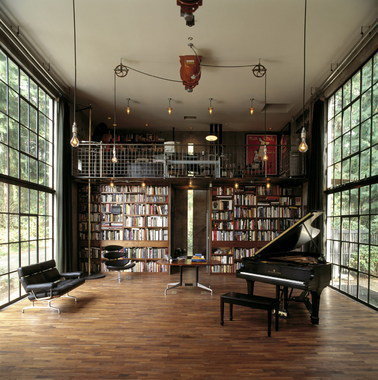
Another tip of the hat today, this time to Bookshelf Porn, the online photo collection for people who *heart* bookshelves, i.e. erotica for book-obsessed individuals like myself. (A big thank you to my art historian friend, Roberto, for sharing this fantastic find.)

Below are a few examples to whet your appetite. More are added to the Bookshelf Porn site daily. By all means, if you have a bookshelf to show off, submit it!

 And I can't resist this one - a rule by which I try to live (she says as she completes her entry for the day). Ah, the contradictions of modern life.


Staying on subject, here's one of those fun intersections of life. I came across this book last week while browsing the shelves at Paper Skyscraper (which is incidentally the best design bookstore and best gift shop overall in Charlotte): Unpacking My Library: Architects and Their Books.

Featuring bookshelves in the offices or homes of starchitects like Tschumi, Williams Tsien, Toshiko Mori, and Michael Graves, the book offers what everyone knows to be the truth about a personal book collection: revelations of heart, soul, and mind. Of course, despite all those big architecture names, it's really the scholar's list I want to see: that of Michael Sorkin, also in the book and a potential subject for a future "I heart" post.

Thursday, July 15, 2010

Tip of the Hat to: Josef Frank

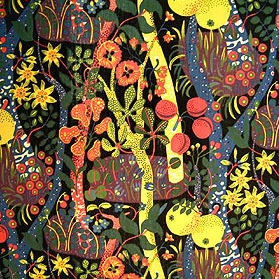
After admiring Google's tip of the hat to Josef Frank this morning, I couldn't help but take another look at his whimsical textile designs. If you're unfamiliar with Frank's work, consider the recent movie version of Mamma Mia! Whether you like musicals or not, the sets in that movie were absolutely breathtaking: clean whites and blues of the Greek coast as backdrop to brilliant textiles, which happen to be, eh hem, Josef Frank designs.
 Textile design by Josef Frank featured in Mamma Mia!

Watching that movie, (and yes, I like musicals), I immediately wanted to know the origin of those fabrics. Leave it to Design*Sponge to show the way. You know it's good design when even 60 years or more after their original creation, the patterns still seem contemporary. Gotta love those Scandinavians. Design is in their blood.
Textile design by Josef Frank
Exhibiting qualities of whimsy and the baroque as well as a surrealist approach to form, Frank's fabrics invoke such a different side of the imagination than his contemporaries in the Bauhaus and moderne movements. When all was being whittled down to streamlines or orthographic formalism, Frank produced these refined but expressive forms that we still love today.
 Textile design by Josef Frank on sofa by Anthropologie

Thursday, July 8, 2010

I Heart Engravings: Never trust an octopus

Of all things I love, books are at the top of my list, right next to millinery, engravings, sea monsters, and all things baroque. Webster's Pictorial Dictionary offers all of this to me within the bounds of a beautiful kiwi green hardcover, complete with gilded title block and sea monster illustration (okay, it's an octopus, but we all know what those can do. I'll just refer you to It Came From Beneath the Sea and King Kong vs. Godzilla. Enough said.)
Ah, rejoice my heart.

And for all of those octopus-defending types - you know who you are - who go on and on about squids being the true culprits of aforementioned crimes:

Case closed.