Thursday, November 18, 2010

Amateur Night

“The sudden bisociation of an idea or event with two habitually incompatible matrices will produce a comic effect, provided that the narrative, the semantic pipeline, carries the right kind of emotional tension. When the pipe is punctured, and our expectations are fooled, the now redundant tension gushes out in laughter, or is spilled in the gentler form of the sou-rire.” – Arthur Koestler, The Act of Creation*
Okay, so this isn’t the only thing that came to mind when I watched an amateur comedy show recently – editing got involved, too.

The show was what you might expect: mediocre comedy with a highlight here and there, mostly jokes on adult themes, body parts and fluids, etc. But comedy, both good and bad, interests me because of its creativity.

Comedy has been a point of reference for those interested in the creative act, especially those who approach art and culture through the lens of psychoanalysis, since the 19th century. Creatively speaking, comedy is the merging of two “habitually incompatible” lines of thought that end up in that non-violent release of tension, aka laughing.

To do this well, to get people rolling in the aisles, the incompatibilities must be “implied in the text.” If you make it explicit (i.e. over-explain the structure upon which the joke is built), you “destroy the story’s comic effect.”** We all know that person who makes the funniest joke not funny by reversing the order of the joke’s elements or explaining the joke’s premise in too great detail. They’ve punctured Koestler’s pipe in too many places. The tension is diffused before that pivotal moment of release – it’s all drip, drip, instead of the desired gush.

For writers, this comes down to the fact that a good joke must be well edited. You can’t give too much away too early, and the punch line can’t be blurted out without the build. Sure, a good comedian must have stage presence and good delivery, too, but even the latter is built on giving the audience time to develop that inner tension based on the smallest number of words up front. Marketing copywriters work with this principle daily – when your audience isn’t expecting what’s coming, the cathartic effect makes them want to pay attention to what you have to say next. And that’s good business.

*p. 51, Arthur Koestler, The Act of Creation, The Macmillan Company: New York, 1964.
**p. 36, Koestler.

Tuesday, November 16, 2010

Hometown Hero


NCDT's David-Ingram (Costume by Erika Diamond. Photo by Jeff Cravotta)
This weekend’s North Carolina Dance Theatre performance was still on my mind this morning so indulge  me for one more post. I took another look at the program, searching for the name of the choreographer and lighting designer on my favorite piece of the night called Arson. That’s when it hit me – Choreographer: David Ingram. I knew it sounded familiar. Ingram hails from East Tennessee, more specifically, Kingsport, Tennessee, which happens to be where yours truly was born and raised. In fact, I think David was Fritz the year I played Clara. Let's just say he's grown up quite a bit since I saw him last, and I approve.
Enough of that, let’s talk about Arson. I’ll admit, the design did it for me: costumes by Lindsey Bruck, set and lighting design by John P. Woodey. The backdrop to the stage was removed, exposing the architecture of the Knight Theater backstage that normally lives hidden from the audience’s view. A single sheet of white fabric draped the back wall from the flyspace to the stage floor.
The great height and added depth were magnified by the performers occupying the stage space and the lighting design, which included several utilitarian metal light cages like those you’d find on a construction site hanging in rows downstage. These pendant lights would increase and decrease in intensity throughout the number, the light shifting from a bright white to a warm yellow, while dancers alternated swinging specific pendants front and back as they moved between and around them.
The effect was such that the entire space of the theater was altered, the scale reconfigured, color drained to sepia tones.  Music by Hangedup, Ben Frost, Rachel Grimes and Piano Magic alternated strings and distortion over heavy bass tones that made the entire theater seem to expand and retract in rhythm like a diaphragm. I was mesmerized.
So here’s to David Ingram, the hometown hero who made his professional choreographic debut at this year’s Innovative Works series, and to the designers, musicians, and performers who made it more than choreography.

Monday, November 15, 2010

Picking up the Slack


NCDT's Kara Wilkes in costume designed by Erika Diamond. Photo by Jeff Cravotta
Thanks to a thoughtful friend, I had the pleasure of attending North Carolina Dance Theatre’s “Innovative Works” performance last Saturday night, which as you might have guessed, featured a series of original pieces by emerging and established choreographers created specifically for the NCDT dancers. While this outpouring of new ideas and energy can sometimes go amiss here and there, Saturday’s performance was one stellar performance after another.
That said, if I had to choose a weak link, it would have to be the opening number, which mixed language and movement in a way that frankly didn’t work. I enjoyed the movement, how can you not enjoy watching these performers own the stage, but the premise – a beatnik-inspired setting complete with bongo drums and moments of spoken word between which the dancers would perform a movement series – seemed oddly dated, considering the “eco” theme that drove the evening’s program. More than that, the words didn’t connect with the movement.
That got me thinking. The arts have such power because they defy words. Art replaces words with movement, sound, images, color. Architecture, too, does a bit of this, offering spatial experience as explanation of what architects do. How do you add words with it becoming forced? Didactic?
Art and architecture should never have to pick up where words leave off or vice versa. It the dialog between the two that gives texture and depth to the experience.
The first number on Saturday night required the dancers to pick up the slack, and, believe me, they did beautifully. While it didn’t detract from my evening, that uneven exchange clarified to me why I care about what I do as a writer and editor in design and the arts. Maybe NCDT will get one of my kind involved next time.

Friday, October 15, 2010

Business Books that won’t turn your stomach or compromise your ethics

Okay, it’s time I put it out there. I’ve answered the same question the same way enough times to know it should have a place here.

When I was starting up my business and hitting the library for resources (thank you, library!), amid the shelves filled with titles on getting rich quick and lessons from CEOs-who-know, I discovered three books that I recommend to every person who asks me how I did it:  Michelle Goodman’s The Anti 9-to-5 Guide and My So-Called Freelance Life and Lauren Bacon and Emira Mears’s The Boss of You.

          
Sure I waded through the many available (and free!) online resources that helped me through the process of choosing a business structure, registering with my local chamber, paying zoning fees for a home office and so forth, but these ladies’ books gave me the guidance and chutzpah to make my business happen and have a good time doing it.

Though they’re writing for women and, yes, most if not all of their examples are women-owned businesses, I recommend these books to my guy friends for the same reasons I recommend them to my ladies. First off, they’re fun reads. The authors have great senses of humor – a necessity for anyone who’s starting their own business – and they offer invaluable advice based on their and fellow business owners’ experiences.

Secondly, they offer something very different from those other books on the topic. They speak to doing business because you want something more than just money or fame or power over the universe. Of course, we all want to make money at the end of the day and I’ll admit sometimes I’d like that power over the universe part, but the point is that money is just one of many reasons most people start their own gig, myself included. As a result, their advice seems so much more honest and authentic than the shallow posturing I find in most other start-up guides.

If you’re green on the business startup process, I recommend reading the books in the order I listed above. Goodman starts from the beginning – she even walks you through finding what you want your business to be if you don’t have any idea yet – then takes you through the logistics of everything from self-discipline to healthcare to taxes. Mears and Bacon are a bit more ambitious and go so far as discussing how to grow your business, find and hire employees, and be a good boss.

Though they started as library loans, I have since purchased all three. Their resource guides and well organized chapters make them go-to references for me even now. Plus I can freely mark the margins, and we all know how I love margins.

Tuesday, September 14, 2010

I Heart Book Sales

I cannot resist a book sale, especially if books on art and architecture are involved and even more especially if the proceeds are for a pet cause of mine. So attention friends: if you live in or plan on visiting the Queen City September 24th or 25th, don’t miss the Art, Architecture, & Photography Used Book Sale at Hodges Taylor Gallery in Uptown Charlotte. Held by the Friends of the Library, all proceeds benefit our local libraries and new boxes will be unpacked continuously so check it out both days if you can. And tell your friends because we in the industry need the reduced prices, Great Recession or no.

For all you dance, music, theater, and film devotees, the Friends of the Library will feature a Book Sale for those areas of interest on Saturday, October 16th, so mark your calendar.

Just in case you're due for an act of all-out altruism, pick up a book or two for me. I'll miss the sale due to a long scheduled trip – horror!

Sunday, September 5, 2010

Man Down: Novice Gaming and Writing for Laughs


Disclaimer: I’m not a gamer. My gaming days ended with Super Mario Brothers 2. I realize that makes me a luddite amongst my peers who at least know how to play Playstation, Wii, or Xbox 360. I know how to use an Xbox as a DVD player.

So I can relate to Nicholson Baker’s recent New Yorker article, “Painkiller Deathstreak,” where he relays the frustration and absolute ridiculousness of being a video game novice. Baker is a great writer and funny, too, which means he’s a really great writer. I love breezily inserted lines like “I wish so many foreigners didn’t have to be shot, so many historical sites damaged without comment, but evidently they do,” or in explaining the portrayal of his death in one game, “the image desaturates to black-and-white and there’s a tactful moment of funereal bagpipery.” When the hero of another game finds a precious, ancient green lamp, Baker empathizes that “being an American action hero, [he] immediately breaks it like a piggy bank on the floor.”

In On Writing Well, (one of my favorite books on the craft), William Zinsser describes humor as a “special angle of vision granted to certain writers who already write good English.” Baker’s account is fantastic humor, and it’s the writing that makes it so – that delicate combination of syntax, phrasing, and wit. Humorists do serious work, as any fan of satire knows, but the presentation sets it apart from other opinion pieces as something accessible if no less controversial.

A novice’s reflections on gaming may not draw great controversy, but gamers’ tolerance to depictions of violence is one of the underlying themes of the article. E.B. White believed, “Humor is a by-product that occurs in the serious work of some and not others.” The product of disparate ideas brought together to shed light on some truth however seemingly small, humor represents the quintessential creative act.

Thursday, September 2, 2010

Model City Economics

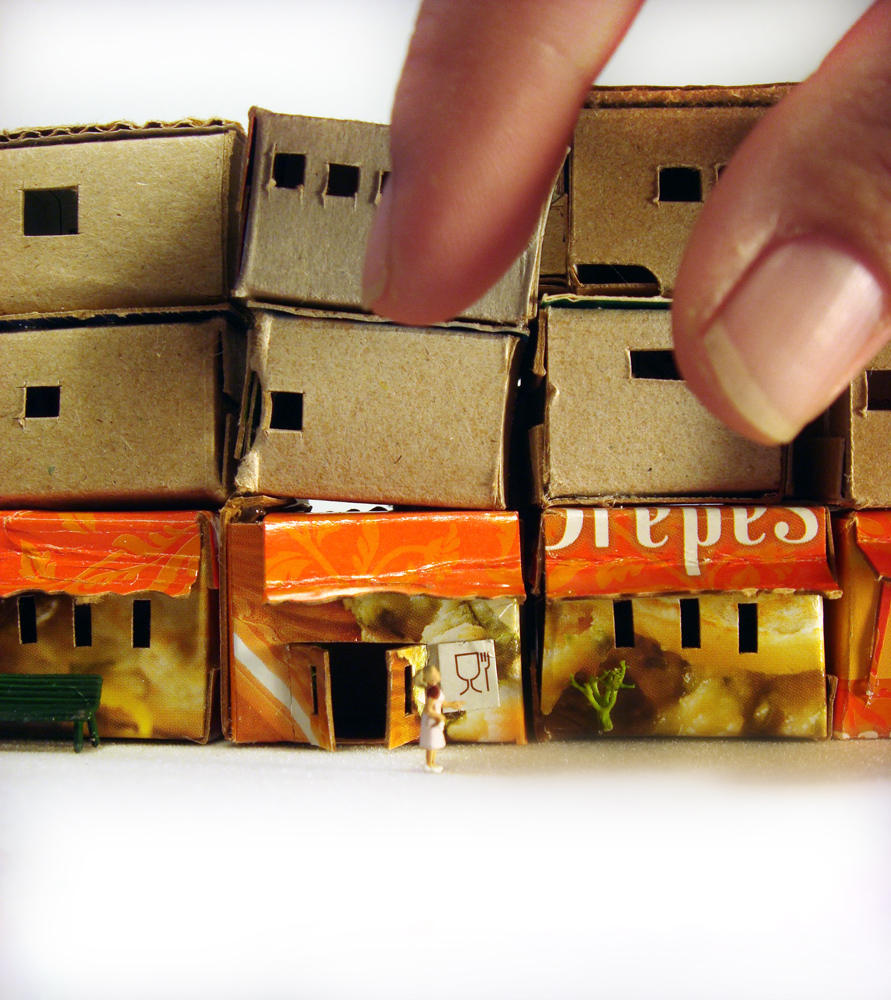
Model cities: who doesn’t love to look at miniatures of real life places and take in the bird’s eye view of a city made comprehensible by its micro-sized rendition. Now imagine that model being made of trash – reclaimed bits of detritus modeled, sculpted, and repurposed into backyards, condo towers, or the great lights of Broadway.

Enter Max Liboiron, an artist and academic who creates “walk-in, miniature dioramas” from a city’s discards. Her most recent work, The New York City Trash Exchange, opening September 9th at the AC Institute, represents none other than the great city itself and is, yes indeed, composed of New York City trash.

Max Liboiron, "The New York City Trash Exchange" (2010)
Liboiron’s work is more than a fun introduction to trash activism. Issues of economy and exchange value play out in the exhibition of the small cities.  In some cases, the parts of the installation are to be taken away by patrons free of charge since the visitor’s own trash might be included in the work itself.

Other installations are based on a barter economy. Visitors are free to take away a piece of the installation as long as they replace it with something of equal or greater value in return. The irony of gauging trash’s value is not lost on artist or viewer.

Max Liboiron, "The Dawson City Trash Project" (2008)
 Liboiron’s work also invokes the archeological, as in Material Afterlife: Circulation where she created 139 lawnscapes and 70 cars then tracked their location as they were taken away by gallery patrons. Liboiron mapped her sculptures’ movement across the continent, like so many migratory birds. For its lowly origins in the city dump, it’s hard not to see the poetry.